Biohazard Cleanup in Austin, TX
Biohazard cleanup typically runs $1,500–$5,000 nationally, per our cost guide. Independent local pros serving Austin, Round Rock, Cedar Park and nearby areas. Describe the problem and we'll route your request — free, no obligation.
- Trained, equipped local teams — discretion is standard, including unmarked vehicles
- Homeowner's insurance often covers death and trauma remediation; many teams bill insurers directly
- Help with victim-compensation paperwork where a crime was involved
- Free, private consultation — no obligation, and no details you'd rather not share
Fast response from independent local providers. No obligation.
Typical national cost$1,500 – $5,000Cost guide →Local Help in Austin, TX
When someone dies at home in Austin, or police are working a crime scene, the investigating agencies come before any cleanup company. This guide covers the Travis County Medical Examiner's role, what the Texas Attorney General's program reimburses for crime scene clean-up and on what conditions, and the rules on worker safety and waste disposal that cover the companies doing the work.
Biohazard Cleanup Team passes requests from families, landlords and property managers in Travis County and neighboring Williamson and Hays County cities to independent cleanup businesses. Those businesses are not our staff; each one inspects the property and gives its own quote.
Austin Service Details
What providers in this area actually see: coverage, common jobs, local pricing factors, and rules worth knowing.
Service Area Notes
- In the Census Bureau's 2020 place-by-county file, the City of Austin has territory in Travis, Williamson, Hays and Bastrop counties.
- The same file places Bee Cave in Travis County, Georgetown in Williamson County, Kyle and Buda in Hays County, and San Marcos in Hays, Caldwell and Guadalupe counties, while Round Rock, Cedar Park, Leander and Pflugerville each have parts in both Travis and Williamson counties.
- The county matters after a death. Article 49.25 of the Code of Criminal Procedure has a medical examiner's inquest held by the medical examiner of the county where the death occurred, so in a city that crosses the Travis–Williamson line, the county of the exact address decides which office is involved.
Common Jobs in Austin
- Cleaning after an unattended death in a house, apartment or condominium, after the investigating agency is finished with the property
- Blood and body-fluid cleanup after a suicide, assault or homicide in a home, garage or car
- Cleanup of a leased unit arranged through the landlord or leasing office, including units rented to students whose families live out of town
- Hoarding cleanouts that involve animal waste, spoiled food or used needles, scheduled around the resident or family
- Tearing out carpet, padding, subfloor sections or drywall that fluids have soaked through, where surface cleaning cannot reach the contamination
What Drives Pricing Here
- HomeGuide, a national cost-guide publisher, puts the average biohazard cleanup at $1,500 to $5,000 per job, or $25 to $150+ per hour, in a guide dated May 3, 2024, and attributes the spread to risk level and the type of contaminant. Treat those as national averages from a third party, not quotes from Austin companies.
- In the guide's biosafety-level table, BSL-2 jobs, the tier it uses for agents such as staph that can cause serious illness through direct contact, run $30 to $80 per hour. HomeGuide's separate deodorization line is roughly $100 an hour, for a smell that remains once the cleanup is done.
- Area and waste also move the total. HomeGuide notes that a bigger affected area takes more time and resources, and that disposal is typically a separate charge from the labor hours; many companies, it says, charge $50 to $500 in total or a fee per container.
- For a crime, the Attorney General's limit is a ceiling on reimbursement rather than a price: its clean-up page says the program will pay up to $2,250 for crime scene clean-up costs for crimes after July 14, 2016, that different limits may apply to earlier crimes, and that the money is split fairly when more than one person paid.
Permits & Local Rules
- Article 49.25 requires counties of more than 2.5 million people to keep a medical examiner's office and lets any other county create one. Where an office exists, Section 6 makes the medical examiner hold inquests into the deaths it lists, among them a person who is killed, dies an unnatural death (except under sentence of the law) or dies in the absence of one or more good witnesses, a suicide, and a death without a physician in attendance when the local health officer or registrar does not know the cause.
- Section 8 covers a death that occurs under the circumstances set out in Section 6: in that case no one may disturb or move the body from the position in which it is found without authorization from the medical examiner or an authorized deputy, except to preserve it from loss or destruction or to keep traffic moving on a highway, railroad or airport.
- The Legislature's statute site shows all of Chapter 49 repealed by H.B. 1610 (2025) effective April 1, 2027. The articles summarized here are the text in effect until then; for a later death, ask the office which rules apply.
- The Travis County Medical Examiner's Office, established in 1977, provides medicolegal death investigation for Travis County and a number of surrounding counties, and is responsible for investigating and certifying the cause and manner of sudden, unexpected, violent, suspicious or unnatural deaths that occur in Travis County. Its counties-served page lists Williamson and Hays among the counties it provides forensic autopsy and laboratory services to for a fee.
- Article 49.02 applies Subchapter A of Chapter 49 to a death in a county that does not have a medical examiner's office or that is not part of a medical examiner's district; under it, a justice of the peace conducts the inquest into listed deaths, including suicides, an unnatural death from a cause other than a legal execution, and a person who dies without having been attended by a physician. Article 49.05 lets the justice direct removal of the body, or move any part of its physical surroundings, only after a law enforcement agency has been notified and a peace officer has investigated, or after a reasonable time has passed if the agency has not begun an investigation. For a death in Georgetown, Kyle, Buda or San Marcos, ask the investigating agency whether a justice of the peace or a medical examiner has the case.
- The Attorney General's eligibility page defines who counts as a victim and who may apply as a claimant, such as someone paying a victim's crime-related bills or authorized to act for a deceased victim; businesses and organizations cannot apply, and the page says the program cannot help with identity theft, regular car accidents or property crime.
- Its basic requirements: the crime happened in Texas to a U.S. resident (or to a Texas resident in a country without victim compensation); the application is filed no later than 3 years after the crime unless good cause for the delay is shown, with special exceptions possible for age or circumstances; police or another law enforcement agency learned of the crime within a reasonable time frame so as not to hinder the investigation or prosecution; the applicant cooperates with the investigation and prosecution (for sex crimes after Sept. 1, 2023, a forensic medical exam counts as cooperation); there is enough evidence that the crime occurred; the applicant did not take part in the crime, commit criminal activity during it (unless that was the result of human trafficking) or do anything illegal that led to it; the applicant was not in jail or prison at the time; and everything given to the program is true and accurate. An applicant who shares some responsibility for the crime may still qualify, the page says, but the payment could be reduced. Special rules apply to sexual assault emergency medical care, for which reporting to law enforcement is not required.
- Chapter 56B of the Code of Criminal Procedure counts reasonable and necessary costs of cleaning the crime scene as pecuniary loss (Article 56B.003), and Article 56B.106(a) caps awards for one victim's injury or death at $50,000 in the aggregate except as that article otherwise provides; the Texas guide on this site covers the rest.
- The clean-up page says the program is a last-resort payer by law, so homeowners' or renters' insurance that applies must be used first. A family that does the cleaning itself is repaid for supplies only; when what the page calls a licensed crime scene cleanup company does the work, its service charges may be repaid as well. Paperwork the page lists: the professional company's bill or receipt, a supply list with costs and a note on what was done, and the insurance declaration page or a statement that there is no insurance.
- The federal Bloodborne Pathogens Standard (29 CFR 1910.1030) reaches every occupational exposure to blood or other potentially infectious materials, and trauma victims and human remains appear in its examples of source individuals. An employer whose workers have that exposure must keep a written Exposure Control Plan, review and update it at least annually and when tasks, procedures or positions affecting exposure change, and supply gloves, gowns, face and eye protection and other appropriate protective equipment at no cost to the employee.
- The standard also requires training at no cost and during working hours, given at initial assignment to exposure tasks and at least annually after that, and hepatitis B vaccine made available once that training is done and no later than 10 working days after the worker is first assigned, except where the worker has already completed the series, antibody tests show immunity, or the vaccine is contraindicated for medical reasons. Contaminated sharps have their own container rules; other regulated waste goes into containers that are closable, built to prevent leakage of fluids, labeled or color-coded, and closed before removal (with a second such container if the outside becomes contaminated), and disposal of all regulated waste must follow applicable federal, state and local regulations.
- On the state side, the Texas Commission on Environmental Quality's medical-waste page lists waste from single or multi-family dwellings, and from hotels, motels or other establishments that provide lodging to the public, among what medical waste does not include. It says those sources are excluded from the definition of health care-related facilities and that the generator may dispose of their waste with regular municipal solid waste, while following TCEQ's recommendations for safely disposing of sharps and syringes.
Local Conditions
- NOAA's 1991–2020 monthly normals for the Austin Bergstrom Airport station (USW00013904) show a normal daily maximum of 96.1°F in July and 97.0°F in August, with a July normal daily minimum of 73.0°F. If anyone knows whether the air conditioning was on and when the home was last occupied, pass that on to the cleanup company before it inspects.
- For a leased unit, settle early with the owner or manager who signs the work authorization, who receives the photos and written scope, and whether the resident's belongings will be inventoried before anything is thrown away. If the tenant was a student whose family lives elsewhere, agree on who will meet the company on site.
Neighborhoods & Suburbs Served
Austin · Round Rock · Cedar Park · Pflugerville · Georgetown · Kyle · Buda · San Marcos · Leander · Bee Cave
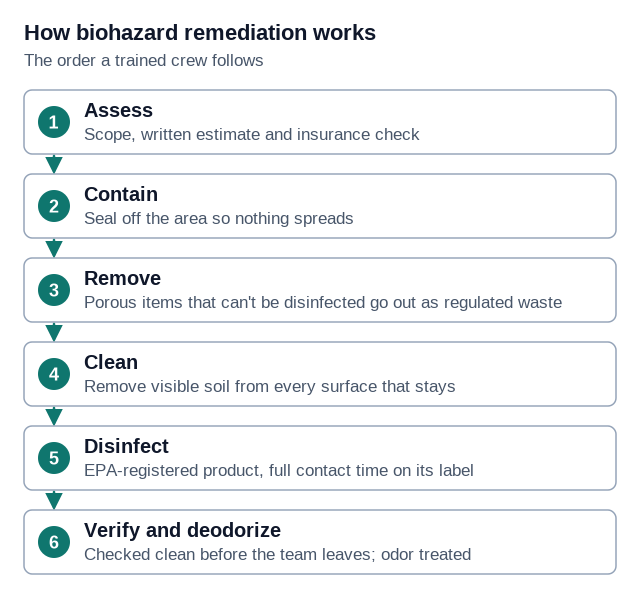
Emergency Response Expectations
This page's form takes requests at any hour. The investigating agency still decides when the property can be entered, and questions about the person who died go to the medical examiner's office or justice of the peace handling the death.
Austin FAQs
When can cleaning start after a death at home in Austin?
Wait until the agencies involved are finished. When a death falls under the circumstances listed in Article 49.25 Section 6, Section 8 bars moving the body without the medical examiner's authorization, apart from its narrow exceptions. Before booking a company, ask the medical examiner's office or the law enforcement agency investigating the death whether it has finished with the property.
How does a family get the body released by the Travis County Medical Examiner?
The office's FAQ says to pick a funeral home, tell the funeral director the Medical Examiner's Office is handling the death, and sign a release form at the funeral home. It says only the legal next of kin may sign under Texas law, that an out-of-town next of kin may authorize release by email or fax, and that the examination generally takes 12 to 24 hours, longer in some cases.
How long until the autopsy report and death certificate are ready?
The Travis County office says it works with the funeral home to complete the death certificate within 10 working days. When more laboratory tests or investigation are needed, it says the autopsy report can take up to 90 days to finalize, and the certificate is issued with the cause listed as pending in the meantime.
Will the Attorney General's program pay for crime scene clean-up in Austin?
It may, for an eligible applicant: up to $2,250 for crimes after July 14, 2016, after any applicable insurance. The apply page says the decision comes by mail, and a denial explains why and how to appeal within 30 days.
Does a death in a Texas home have to be disclosed to a buyer?
Texas Property Code § 5.008(c) says a seller or seller's agent has no duty to disclose or release information about whether a death by natural causes, suicide, or accident unrelated to the condition of the property occurred on the property. The section's disclosure notice applies to residential property of not more than one dwelling unit, with transfers listed in subsection (e) exempt; for any other situation, ask a Texas real estate attorney.
Sources
- Travis County Medical Examiner's Office
- Travis County Medical Examiner: FAQ
- Travis County Medical Examiner: Counties served
- Texas Legislature: Code of Criminal Procedure Chapter 49, inquests and medical examiners
- Texas Legislature: Code of Criminal Procedure Chapter 56B, Crime Victims' Compensation
- Texas Legislature: Property Code Chapter 5 (§ 5.008)
- Texas OAG: Crime Scene Clean-Up Reimbursement
- Texas OAG: Crime Victims' Compensation eligibility
- Texas OAG: Apply for Crime Victims' Compensation
- eCFR: 29 CFR 1910.1030, Bloodborne Pathogens
- TCEQ: What is medical waste?
- NOAA NCEI: 1991–2020 monthly normals, Austin Bergstrom Airport (USW00013904)
- U.S. Census Bureau: 2020 Texas places by county
- HomeGuide: Biohazard cleanup cost guide, May 3, 2024 (third-party estimate)
Last reviewed 2026-11-06
Services Available in Austin
Biohazard Cleanup
Professional remediation of biohazardous materials by trained, equipped local teams — discreet, thorough, and respectful.
Learn more →Crime Scene Cleanup
After authorities release the scene, discreet local teams restore the space — with help navigating insurance and state victim-compensation programs.
Learn more →Unattended Death Cleanup
Compassionate, discreet remediation after a loved one has passed alone — handled by trained local teams so family doesn't have to go back inside.
Learn more →Blood & Trauma Cleanup
Discreet professional cleanup after accidents and medical emergencies — trained local teams, safe disinfection, insurance-ready documentation.
Learn more →Hoarding Cleanup
Respectful, judgment-free hoarding remediation — local teams that work at the pace the situation and family need.
Learn more →Free Tools Before You Call
Ballpark the cost or narrow down the problem before talking to an Austin provider.
Biohazard Cleanup Cost Estimator
A calm, honest cost range for professional cleanup — and why insurance often means families pay little out of pocket.
Use the free tool →Who Pays for Crime Scene Cleanup? State Victim Compensation Lookup
Most state victim compensation programs reimburse crime scene cleanup. Look up your state's coverage, cap, official source, and where to apply.
Use the free tool →What To Do After an Unattended Death — A Gentle Checklist
A calm, step-by-step guide for the first hours and days — answer three gentle questions and get a checklist for your exact situation.
Use the free tool →Need help in Austin, TX?
Send the short form — urgent requests get priority routing.