Biohazard Cleanup in Houston, TX
Biohazard cleanup typically runs $1,500–$5,000 nationally, per our cost guide. Independent local pros serving Houston, Pasadena, Pearland and nearby areas. Describe the problem and we'll route your request — free, no obligation.
- Trained, equipped local teams — discretion is standard, including unmarked vehicles
- Homeowner's insurance often covers death and trauma remediation; many teams bill insurers directly
- Help with victim-compensation paperwork where a crime was involved
- Free, private consultation — no obligation, and no details you'd rather not share
Fast response from independent local providers. No obligation.
Typical national cost$1,500 – $5,000Cost guide →Local Help in Houston, TX
This page is for Houston-area families, landlords and property managers facing cleanup after a death, a suicide or a violent crime. It covers which office investigates the death, what the Texas Attorney General's compensation program repays for crime scene clean-up and who can claim it, and the safety and waste rules that cover cleanup companies.
Biohazard Cleanup Team forwards requests to independent Houston-area cleanup businesses. They are separate companies, not our employees. Before agreeing to any work, ask the company to assess the property and give you a written estimate.
Houston Service Details
What providers in this area actually see: coverage, common jobs, local pricing factors, and rules worth knowing.
Service Area Notes
- Houston city is entered under Harris, Fort Bend, Montgomery and Waller counties in the Census Bureau's 2020 file matching places to counties.
- The same file places Pasadena, Humble, Bellaire and the Spring census-designated place in Harris County alone and Sugar Land in Fort Bend County alone. Baytown appears in Harris and Chambers counties, Katy in Harris, Fort Bend and Waller, Pearland in Harris, Fort Bend and Brazoria, and The Woodlands census-designated place in Montgomery and Harris.
- County lines matter because Article 49.25 gives the inquest to the medical examiner of the county in which the death occurred. Fort Bend County has its own Medical Examiner's Office, which the county says opened in December 2019, so a death in Sugar Land or the Fort Bend part of Houston would ordinarily go to that office rather than to Harris County's. For any address outside Harris County, the officers at the scene can confirm which office has the death.
Common Jobs in Houston
- Cleaning a house or apartment after an unattended death, once police and the medical examiner's office no longer need the property
- Removing blood and other body fluids after a suicide, an assault or a homicide, whether in a house, a garage or a vehicle
- Cutting out porous materials, such as carpet pad or the lower part of a wall, that absorbed fluids
- Clearing a severely cluttered home where waste has built up, at a pace the occupant or family agrees to
- Sewage backup cleanup, which HomeGuide lists among the jobs biohazard professionals handle
What Drives Pricing Here
- HomeGuide's cost guide, written May 3, 2024, gives national averages of $1,500 to $5,000 for a whole job and $25 to $150+ for an hour of work, and says where a job lands depends on its risk level and what kind of contaminants are present. None of those numbers comes from a Houston company.
- Its hourly rates climb with the four CDC biosafety levels the guide uses to classify biohazards, $25 to $50 at BSL-1, $30 to $80 at BSL-2, $50 to $150 at BSL-3 and $150 to $600 at BSL-4; the guide says higher risk means higher costs for protective equipment and decontamination.
- The guide adds that labor hours and waste disposal are typically priced separately, with many companies charging $50 to $500 in all or a fee per container. Deodorization, for a smell still there once cleanup is done (a sewage spill is its example), is about $100 an hour.
- If a crime caused the damage, the Attorney General's clean-up page caps reimbursement at up to $2,250 for crime scene clean-up costs for crimes after July 14, 2016, which is a limit on repayment, not a price. For crimes before that date, different limits may apply, and when several people paid, the money is split fairly.
Permits & Local Rules
- Code of Criminal Procedure Article 49.25 requires the commissioners court of any county with a population of more than 2.5 million, counted by the last preceding federal census, to establish and maintain a medical examiner's office. The Harris County Institute of Forensic Sciences calls itself the county's medical examiner's office and says that article requires it to determine cause and manner of death for people who die suddenly, unexpectedly, under suspicious circumstances, from drug or chemical toxicity, or from any type of injury.
- The article's Section 6(a) inquest list includes anyone killed, anyone who from any cause dies an unnatural death except under sentence of the law, anyone who dies in the absence of one or more good witnesses, and any suicide or death whose circumstances suggest suicide. Under Section 7, a police officer, an institution's superintendent or general manager, a physician or a private citizen who becomes aware of a death in any of the Section 6(a) circumstances must immediately report it to the office of the medical examiner or to the city or county police departments, which pass it to the medical examiner at once.
- Section 8 then forbids anyone to disturb or remove the body from the position in which it is found, when the death falls under Section 6, unless the medical examiner or an authorized deputy allows it; the only exceptions are preserving the body from loss or destruction and maintaining the flow of traffic on a highway, railroad or airport. Hold off on any cleaning until the police and the medical examiner's office are finished at the property, and ask them, not a cleanup company, when that is. The Legislature's statute site notes that Chapter 49 was repealed by H.B. 1610 (2025) with an effective date of April 1, 2027; for a death after that date, ask the medical examiner's office which rules govern it.
- Code of Criminal Procedure Chapter 56B governs the compensation program. Article 56B.106(a) holds the combined awards to a victim and any other claimant with a pecuniary loss from that victim's injury or death to $50,000, unless another part of the article provides otherwise, and Article 56B.462 makes the compensation fund and its auxiliary fund the payers of last resort. The filing-deadline and crime-reporting articles, 56B.052 and 56B.053, carry their own extensions and exceptions, including rules for child victims, so read them or ask the program before deciding a claim is too late.
- The program's eligibility page says businesses and organizations cannot apply, so a landlord's company or a management firm cannot claim clean-up costs itself, and identity theft, regular car accidents and property crime are outside what the program can help with. Its claimant categories include, among others, a person who pays a victim's crime-related bills and a person authorized to act for a victim who has died; the full lists of victim and claimant categories are on that page.
- The page's basic requirements fall into three groups. Place and status: the person applying is a victim or claimant, and the crime took place in Texas with a U.S. resident as the victim, or abroad, in a country lacking victim compensation, with a Texas resident as the victim. Timing and police contact: an application within 3 years of the crime, unless there is good cause for a delay, with special exceptions possible based on age or circumstances, and a report to law enforcement within a reasonable time frame so the investigation or prosecution is not hindered. Conduct: cooperation with law enforcement's investigation and prosecution, which a forensic medical exam satisfies for sex crimes after Sept. 1, 2023; enough evidence to show a crime took place, no participation in the crime, no criminal activity during it unless it resulted from human trafficking, nothing illegal that led to it, no time in prison or jail when it happened, and only true and accurate information given to the program. A person who shares some responsibility may still qualify, though the payment could be reduced, and sexual assault Emergency Medical Care follows special rules that do not require a report to law enforcement.
- For clean-up claims, the Attorney General's page calls the program a last-resort option by law: other sources an applicant qualifies for, such as homeowners' or renters' insurance, must be used first. People who clean the scene themselves are reimbursed only for cleaning supplies, while a licensed crime scene cleanup company's service costs may also be reimbursed. It asks for the company's bill or receipt, an itemized cost of supplies with an explanation of services rendered, and either the declaration page of a homeowners' or renters' policy or a statement of no insurance.
- Cleanup work that exposes employees to blood or other potentially infectious materials falls under OSHA's bloodborne pathogens rule at 29 CFR 1910.1030, which names trauma victims and human remains among possible source individuals and requires universal precautions. It has employers disinfect contaminated work surfaces after procedures, immediately or as soon as feasible after overt contamination or a spill, and at the end of the shift if contamination may have occurred since the last cleaning, and it bars picking up possibly contaminated broken glass by hand, naming a brush and dust pan, tongs or forceps instead. Every kind of regulated waste must go out under the federal, Texas and local disposal rules that apply.
- TCEQ's medical-waste page lists what medical waste does not include, and homes are on that list: single- and multi-family dwellings, along with hotels, motels and other lodging establishments, are outside the agency's definition of health care-related facilities. The page says waste from these sources may be disposed of by the generator with regular municipal solid waste, though TCEQ asks people to follow its GI-418 recommendations for sharps and syringes.
Local Conditions
- In NOAA's monthly climate normals for 1991–2020, the Houston Intercontinental Airport station (USW00012960) has a normal daily maximum of 94.5°F for July and 94.9°F for August, while the normal daily minimum for July is 75.7°F. When a death went unnoticed in a warm month, it helps to tell the company, at first contact, whether the cooling was running and roughly how long the home was shut.
- The Institute says it collects only the personal property found on the person at the time of death, and releases what a law enforcement investigation does not need to the family's chosen funeral home. For the rest of the home, agree in writing with the cleanup company how it will set aside valuables, papers and photographs.
Neighborhoods & Suburbs Served
Houston · Pasadena · Pearland · Sugar Land · Katy · Baytown · Humble · Bellaire · The Woodlands · Spring
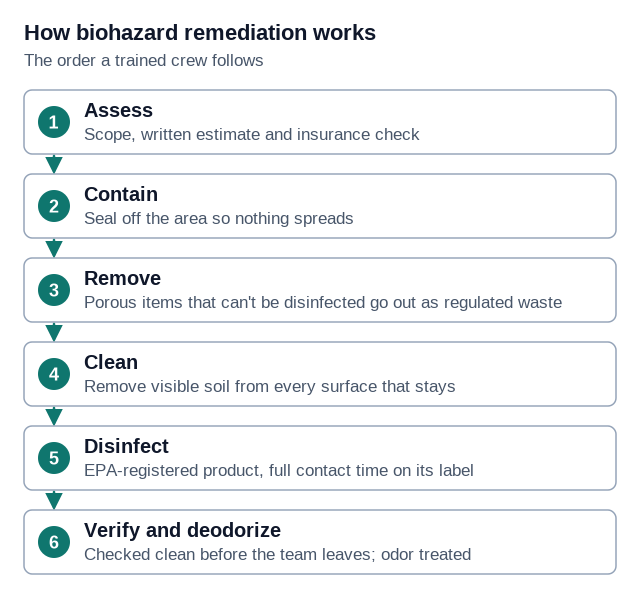
Emergency Response Expectations
The request form on this page can be sent at any hour. Until the police and the medical examiner's office have finished, follow their instructions about the property; for anything about the person who died, contact the Harris County Institute of Forensic Sciences, or the Fort Bend County Medical Examiner's Office for a death in that county.
Houston FAQs
What does the family need to do when the Harris County Institute of Forensic Sciences has the death?
The Institute's FAQ says the legal next-of-kin chooses a funeral home, tells the funeral director the Institute is handling the death, and signs a release form, which the Institute posts online if the funeral home does not have it. Its family brochure says it uses Texas Health and Safety Code Section 711.002 to decide who the legal next-of-kin is for disposition of the remains. The brochure is dated August 2021, and the current statute's priority list includes a tier the brochure does not print (the duly qualified executors or administrators of the estate), so if there is any question about who may sign, ask the Institute.
How soon is the body released, and is there a charge for the autopsy?
The Institute's FAQ says most bodies are examined and released within 24 hours, though some circumstances may require as long as 72 hours. It states there is no charge to the public for an autopsy. Not every case gets one: the medical examiners on duty decide after reviewing the case, and while a family's wishes for or against an autopsy are considered, the decision rests with the pathologist and some circumstances require one.
Can the Attorney General's program repay a Houston family for crime scene clean-up?
It can. An eligible applicant may be repaid up to $2,250 when the crime came after July 14, 2016, once any homeowners' or renters' insurance that applies has been used. The program's apply page says it mails its decision, and a denial gives the reasons and explains the 30-day appeal window.
Sources
- Harris County Institute of Forensic Sciences: Answers to Frequently Asked Questions
- Harris County Institute of Forensic Sciences: Family Information Brochure (PDF)
- Fort Bend County: Medical Examiner's Office
- Texas Legislature: Code of Criminal Procedure Chapter 49, inquests and medical examiners
- Texas Legislature: Code of Criminal Procedure Chapter 56B, Crime Victims' Compensation
- Texas OAG: Crime Scene Clean-Up Reimbursement
- Texas OAG: Crime Victims' Compensation eligibility
- Texas OAG: Apply for Crime Victims' Compensation
- eCFR: 29 CFR 1910.1030, Bloodborne Pathogens
- TCEQ: What is medical waste?
- NOAA NCEI: 1991–2020 monthly normals, Houston Intercontinental Airport (USW00012960)
- U.S. Census Bureau: 2020 Texas places by county
- HomeGuide: Biohazard cleanup cost guide, May 3, 2024 (third-party estimate)
Last reviewed 2026-11-07
Services Available in Houston
Biohazard Cleanup
Professional remediation of biohazardous materials by trained, equipped local teams — discreet, thorough, and respectful.
Learn more →Crime Scene Cleanup
After authorities release the scene, discreet local teams restore the space — with help navigating insurance and state victim-compensation programs.
Learn more →Unattended Death Cleanup
Compassionate, discreet remediation after a loved one has passed alone — handled by trained local teams so family doesn't have to go back inside.
Learn more →Blood & Trauma Cleanup
Discreet professional cleanup after accidents and medical emergencies — trained local teams, safe disinfection, insurance-ready documentation.
Learn more →Hoarding Cleanup
Respectful, judgment-free hoarding remediation — local teams that work at the pace the situation and family need.
Learn more →Free Tools Before You Call
Ballpark the cost or narrow down the problem before talking to a Houston provider.
Biohazard Cleanup Cost Estimator
A calm, honest cost range for professional cleanup — and why insurance often means families pay little out of pocket.
Use the free tool →Who Pays for Crime Scene Cleanup? State Victim Compensation Lookup
Most state victim compensation programs reimburse crime scene cleanup. Look up your state's coverage, cap, official source, and where to apply.
Use the free tool →What To Do After an Unattended Death — A Gentle Checklist
A calm, step-by-step guide for the first hours and days — answer three gentle questions and get a checklist for your exact situation.
Use the free tool →Need help in Houston, TX?
Send the short form — urgent requests get priority routing.