Biohazard Cleanup in Charlotte, NC
Biohazard cleanup typically runs $1,500–$5,000 nationally, per our cost guide. Independent local pros serving Charlotte, Matthews, Mint Hill and nearby areas. Describe the problem and we'll route your request — free, no obligation.
- Trained, equipped local teams — discretion is standard, including unmarked vehicles
- Homeowner's insurance often covers death and trauma remediation; many teams bill insurers directly
- Help with victim-compensation paperwork where a crime was involved
- Free, private consultation — no obligation, and no details you'd rather not share
Fast response from independent local providers. No obligation.
Typical national cost$1,500 – $5,000Cost guide →Local Help in Charlotte, NC
In Charlotte, cleaning up after someone dies at home or is hurt in a violent crime comes after police and, for the deaths listed in G.S. 130A-383, the county medical examiner have done their part. This page covers that statute, the Mecklenburg County Medical Examiner's Office, North Carolina's victim compensation rules, and the safety and medical-waste rules for the companies doing the work.
This site passes requests from families, landlords and property managers in Mecklenburg County and neighboring towns to independent cleanup companies. Those companies are not our employees; each one looks at the property and sets its own price.
Charlotte Service Details
What providers in this area actually see: coverage, common jobs, local pricing factors, and rules worth knowing.
Service Area Notes
- In the Census Bureau's 2020 North Carolina listing of places and the counties they sit in, Charlotte city, Cornelius, Huntersville, Matthews and Pineville appear under Mecklenburg County, and Mint Hill appears under both Mecklenburg and Union counties.
- The same listing puts Concord in Cabarrus County and Gastonia in Gaston County. The South Carolina version puts Rock Hill and Fort Mill in York County, where North Carolina's statutes and programs do not apply.
- The county line decides which medical examiner is involved: G.S. 130A-383 directs notice to the medical examiner of the county in which the body is found, so a death in Concord is reported in Cabarrus County, not Mecklenburg.
Common Jobs in Charlotte
- Removing soaked flooring, bedding, upholstered furniture and drywall after a death that was not discovered right away
- Blood and body-fluid cleanup in a house, apartment, garage or car after a suicide, assault or homicide
- Preparing a rental unit for the next tenant after a resident who lived alone has died, working with the landlord or management company
- Hoarding cleanouts where animal waste, spoiled food or used needles are mixed with belongings, scheduled around the resident or family
- Collecting needles, blood and human waste left in vacant buildings, stairwells or outdoor areas on private property
What Drives Pricing Here
- HomeGuide, a third-party cost publisher, dates its biohazard cleanup guide May 3, 2024. It puts the total average at $1,500 to $5,000, or $25 to $150+ per hour, and says the risk level and the contaminants involved drive the cost. Those are the publisher's averages, not quotes from Charlotte companies.
- In the same guide, BSL-2 work (the level HomeGuide uses for microbes and materials that can make people seriously ill through direct contact) averages $30 to $80 per hour, and deodorizing a property where an odor remains once cleanup is done runs about $100 an hour.
- The guide also names the size of the affected area as a cost factor, and says disposal is usually billed apart from labor, often at $50 to $500 in total or as a fee per container.
- Under G.S. 15B-11(g), compensation to a victim and all other claimants for that victim may not exceed $45,000 in the aggregate, in addition to allowable funeral, cremation and burial expenses, which G.S. 15B-2 limits to $10,000. NC DPS lists crime scene cleanup as an accepted expense and describes the program as a payer of last resort, so insurance is claimed first; it says deductibles and co-pays may be reimbursed.
Permits & Local Rules
- G.S. 130A-383(a) requires notice to the medical examiner for deaths that result from violence, poisoning, accident, suicide or homicide, sudden deaths when the person seemed to be in good health, deaths with no attending physician, deaths in custody or in certain State facilities, and deaths under any suspicious, unusual or unnatural circumstance; the subsection gives the full list and says who may give notice, from a physician or officer to a relative or any other person who suspects such a death.
- The same subsection bars anyone from disturbing the body at the scene until the medical examiner authorizes it. The one exception: when the medical examiner is unavailable, the appropriate law enforcement agency may decide that leaving the body in place would risk its integrity or endanger others. Under subsection (c), once the investigation is finished the medical examiner releases the body to the next of kin or another person who will take responsibility for final disposition.
- The Mecklenburg County Medical Examiner's Office says it provides morgue and forensic pathology services to Mecklenburg County residents, and consultation and forensic pathology services to Cleveland and Gaston counties.
- NC DPS treats a claim as possibly eligible when the answer to each of these is yes: the crime occurred in North Carolina; it was reported within six months; the victim suffered a direct physical or psychological injury; the victim lost income or faced expenses for eligible services in the first year after the crime; and the victim was not committing a crime when injured. Victims need not be North Carolina residents. G.S. 15B-11(a)(3) accepts a later report when good cause excuses the delay, and subsection (a)(2) allows a longer window for losses when the victim was 18 or younger at the time of injury.
- Applications are generally due no more than two years after the crime. NC DPS names two situations that extend this: the unreported sexual assault of a minor child, and the discovery of a missing person who is found to have been a homicide victim. G.S. 15B-11 also lists other grounds on which an award must or may be denied or reduced, so check that section or ask the office before counting on a payment.
- For a cleanup claim, NC DPS asks for the itemized bill from a certified biohazard cleanup company, and says the services may include repair or replacement of doors, locks and windows as well as cleanup of blood stains. Applications also need a law enforcement report. The program lists these as not accepted: property damage or loss, lost or stolen money, replacement of property taken as evidence, court fees and expenses, pain and suffering, utilities, mortgage or rent, and travel. NC DPS gives an average processing time of three to six months from receipt of the application.
- North Carolina's rule 13 NCAC 07F .0101 adopts the federal Part 1910 standards published in the Federal Register on or before February 13, 2026, without later amendments and except as changed in 13 NCAC 07F .0103, which amends only 1910.120; the bloodborne pathogens standard, 1910.1030, is not changed. That standard reaches every occupational exposure to blood or to the other potentially infectious materials defined in paragraph (b), and it lists trauma victims and human remains as examples of source individuals.
- An employer covered by 1910.1030 must keep a written Exposure Control Plan and revisit it at least once a year, and also whenever tasks, procedures or employee positions change in ways that affect exposure. Protective equipment is the employer's expense: it must be supplied, cleaned, laundered, disposed of, repaired and replaced without charge to the worker.
- Training is free, during working hours, at initial assignment and within one year of the previous session, plus added training when new or changed tasks affect exposure. The employer must offer the hepatitis B vaccine after the vaccine training the standard requires and no later than 10 working days after initial assignment. The exceptions are a completed prior series, antibody testing showing immunity, or a medical contraindication; an employee who declines signs the Appendix A statement and may accept the vaccine later while still covered.
- The federal standard leaves disposal of regulated waste to the applicable regulations of the United States, the states and their political subdivisions. In North Carolina, G.S. 130A-309.26 directs the rules for packaging, storing, treating and disposing of medical waste. Under 15A NCAC 13B .0101, regulated medical waste means blood and body fluids in individual containers of more than 20 milliliters, together with microbiological and pathological waste, that have not been treated under Rule .1204.
- Rule .1202 requires sharps to go in a rigid container that is puncture-resistant and leak-proof when upright, and bars compacting them before off-site transport unless they are in a sealed compactor unit the transporter hauls away. Blood and body fluids in individual containers of more than 20 milliliters must go to a sanitary sewer after the local sewage treatment authority has been notified, or be treated by incineration or steam sterilization. All regulated medical waste must undergo treatment within 60 calendar days of shipment from the generator; unrefrigerated waste must be treated within 21 calendar days of shipment, and waste not treated within those 21 days must be refrigerated at no more than 45°F. Those three time and temperature limits do not apply to medical waste treated at the generating facility.
- Rule .1203 sets the packaging and labeling standards for regulated medical waste and requires the universal biohazard symbol to be displayed on each side and at the back of a transport vehicle's cargo area. Ask the company how it will package what it removes and which permitted facility will treat it.
Local Conditions
- Monthly climate normals for 1991–2020 from NOAA's station at Charlotte Douglas Airport give a normal July daily high of 90.3°F and a normal July daily low of 69.9°F. The same table puts the July average at 18.0 days with a high of 90°F or more. If a death in a closed house is found in summer, tell the company how long the home was shut and whether the cooling system was running before it writes the scope.
- G.S. 28A-25-7 gives landlords an affidavit procedure, filed with the clerk of court in the county where the unit is located, for taking possession of belongings left by a tenant who was the sole occupant and died. It applies only after waiting-period and estate conditions are met, sets out what the affidavit must contain and who must be notified, has a separate route for property worth $500 or less, and leaves summary ejectment under Chapter 42 as an alternative. Check the statute, or ask the clerk of court, before the unit is emptied.
- Mecklenburg's medical examiner says personal property on a decedent is usually removed at the place of death and turned over to the family or to law enforcement. In homicide cases, it says, items considered evidence go to the investigating agency. Agree with the family about anything left in the home before the company bags porous items for disposal.
Neighborhoods & Suburbs Served
Charlotte · Matthews · Mint Hill · Huntersville · Cornelius · Concord · Gastonia · Pineville · Rock Hill, SC · Fort Mill, SC
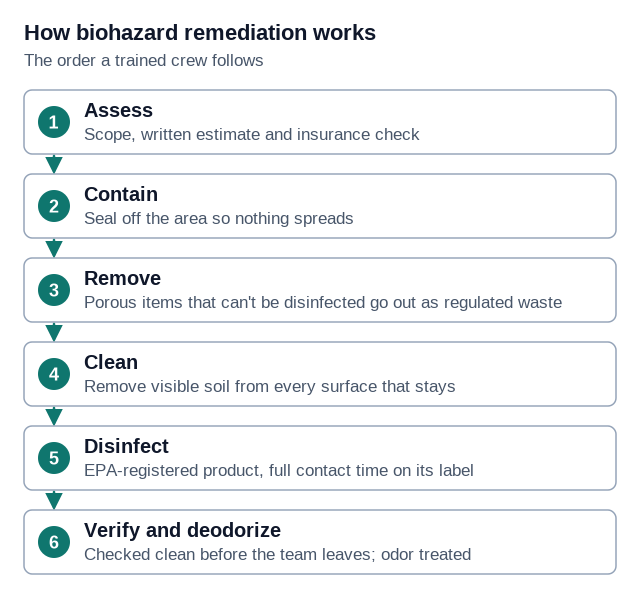
Emergency Response Expectations
You can send a request through this page at any time of day. Before a company is scheduled, confirm that the investigating agency is done at the property, and direct questions about the person who died, or about the death certificate, to the medical examiner's office.
Charlotte FAQs
Who should we check with before cleanup starts after a death in a Charlotte home?
The investigating law enforcement agency: ask it whether it has finished with the home before booking a company. Separately, state law bars disturbing the body at the scene until the medical examiner authorizes it, except where law enforcement decides, while the medical examiner is unavailable, that leaving the body would risk its integrity or endanger others.
How soon does the Mecklenburg medical examiner release the body to a funeral home?
The office's FAQ says a body is typically available for release to a funeral home or cremation service within 24 to 48 hours, unless extenuating circumstances call for more examination or investigation. It says final reports can take up to three or four months and are made available through the state Chief Medical Examiner's Office.
Does the family pay for the medical examiner's examination?
No. The Mecklenburg office says cases accepted under medical examiner jurisdiction are paid for by the County or State, and that it does not perform private autopsies.
We live in Rock Hill. Can we use the North Carolina program?
Not for a crime that happened in South Carolina: NC DPS asks whether the crime occurred in North Carolina. South Carolina's Department of Crime Victim Compensation says in its FAQ that it cannot pay for crime scene clean-up, so check homeowner's or renter's insurance and ask the company for an itemized estimate.
Does homeowner's insurance usually pay for this kind of cleanup?
HomeGuide says homeowners insurance covers most biohazard cleanup projects, since most result from an accident rather than neglect or intentional harm, and that many companies work with the insurer for the customer. Coverage depends on the policy, so call the carrier before work begins.
Must a North Carolina seller disclose that someone died in the house?
G.S. 39-50 says the fact that a previous occupant died or had a serious illness in the property is not a material fact when the property is offered for sale. The statute also says no seller may knowingly make a false statement about it.
Should a crawl-space house be checked from underneath?
If fluids soaked through the flooring of a house built over a crawl space, ask the company to inspect the subfloor, joists and insulation from below and to list in writing what it removed.
Sources
- NC DPS: Victim Compensation Program
- N.C. General Statutes: Chapter 15B, Crime Victims Compensation Act
- N.C. General Statutes: Chapter 130A, Article 16 (G.S. 130A-383)
- Mecklenburg County Medical Examiner's Office: About
- Mecklenburg County Medical Examiner's Office: FAQ
- eCFR: 29 CFR 1910.1030, Bloodborne Pathogens
- NCAC: 13 NCAC 07F .0101 (general industry standards)
- NCAC: 13 NCAC 07F .0103 (hazardous materials amendment)
- N.C. General Statutes: G.S. 130A-309.26 (medical waste)
- NCAC: 15A NCAC 13B .0101 (definitions)
- NCAC: 15A NCAC 13B .1202 (medical waste requirements)
- NCAC: 15A NCAC 13B .1203 (packaging, generators and transporters)
- N.C. General Statutes: G.S. 28A-25-7 (deceased tenant's property)
- N.C. General Statutes: G.S. 39-50
- South Carolina Attorney General: Crime Victim Compensation FAQs
- NOAA NCEI: 1991–2020 monthly normals, Charlotte Douglas Airport (USW00013881)
- U.S. Census Bureau: 2020 North Carolina places by county
- U.S. Census Bureau: 2020 South Carolina places by county
- HomeGuide: Biohazard cleanup cost guide, May 3, 2024 (third-party estimate)
Last reviewed 2026-11-06
Nearby Counties
Services Available in Charlotte
Biohazard Cleanup
Professional remediation of biohazardous materials by trained, equipped local teams — discreet, thorough, and respectful.
Learn more →Crime Scene Cleanup
After authorities release the scene, discreet local teams restore the space — with help navigating insurance and state victim-compensation programs.
Learn more →Unattended Death Cleanup
Compassionate, discreet remediation after a loved one has passed alone — handled by trained local teams so family doesn't have to go back inside.
Learn more →Blood & Trauma Cleanup
Discreet professional cleanup after accidents and medical emergencies — trained local teams, safe disinfection, insurance-ready documentation.
Learn more →Hoarding Cleanup
Respectful, judgment-free hoarding remediation — local teams that work at the pace the situation and family need.
Learn more →Free Tools Before You Call
Ballpark the cost or narrow down the problem before talking to a Charlotte provider.
Biohazard Cleanup Cost Estimator
A calm, honest cost range for professional cleanup — and why insurance often means families pay little out of pocket.
Use the free tool →Who Pays for Crime Scene Cleanup? State Victim Compensation Lookup
Most state victim compensation programs reimburse crime scene cleanup. Look up your state's coverage, cap, official source, and where to apply.
Use the free tool →What To Do After an Unattended Death — A Gentle Checklist
A calm, step-by-step guide for the first hours and days — answer three gentle questions and get a checklist for your exact situation.
Use the free tool →Need help in Charlotte, NC?
Send the short form — urgent requests get priority routing.