Biohazard Cleanup in San Diego, CA
Biohazard cleanup typically runs $1,500–$5,000 nationally, per our cost guide. Independent local pros serving San Diego, Chula Vista, Oceanside and nearby areas. Describe the problem and we'll route your request — free, no obligation.
- Trained, equipped local teams — discretion is standard, including unmarked vehicles
- Homeowner's insurance often covers death and trauma remediation; many teams bill insurers directly
- Help with victim-compensation paperwork where a crime was involved
- Free, private consultation — no obligation, and no details you'd rather not share
Fast response from independent local providers. No obligation.
Typical national cost$1,500 – $5,000Cost guide →Local Help in San Diego, CA
When a death at home in San Diego County is sudden, unexpected, or tied to an injury or intoxication, the county's Department of the Medical Examiner is involved. Its process page says deaths of a sudden and unexpected nature are generally investigated, and that a death falls under its jurisdiction when an injury or intoxication merely contributed to it, even in a small way, or is suspected to have contributed.
Paid cleanup of what remains is regulated by the state. Under Health and Safety Code § 117778, a person who removes human blood, human body fluids and other associated residues from the scene of a serious injury, illness or death as a commercial activity is a trauma scene waste management practitioner, and § 118321.1(a) says that practitioner shall register with the California Department of Public Health (CDPH); § 118321.6(b) still lets a business employ or contract with someone, an industrial hygienist for example, for cleanup or consultative services that are incidental to the principal course and scope of that person's services. Requests sent through this site from San Diego County are passed to independent providers, and the California guide linked below covers the statewide rules in more depth.
San Diego Service Details
What providers in this area actually see: coverage, common jobs, local pricing factors, and rules worth knowing.
Service Area Notes
- Each place named on this page is an active incorporated city that the Census Bureau's 2020 place-by-county reference file lists in San Diego County: San Diego, Chula Vista, Oceanside, Escondido, Carlsbad, El Cajon, Vista, La Mesa, National City and Santee.
- Military installations are a different workplace jurisdiction. OSHA's California State Plan page excepts from State Plan coverage private-sector employers within the secured borders of U.S. military installations where access is controlled, other than state and local government employers there, and says federal OSHA covers what the State Plan does not. A private cleanup crew working inside such a base is therefore under federal OSHA, whose bloodborne pathogens rule is 29 CFR 1910.1030.
Common Jobs in San Diego
- Unattended death cleanup in houses, condominiums and apartments once the Medical Examiner has finished at the scene
- Homicide, suicide and assault scene cleanup after the investigating agency releases the home
- Car, RV, trailer and mobile home cleanup; HSC § 117776(b) says a trauma scene can be a structure that is not fixed geographically
- Rental move-out cleanup when the tenant, or a military household on new orders, has already left the area
- Hoarding cleanouts scheduled around the resident and family
- Estate cleanouts for relatives clearing a home after a death
What Drives Pricing Here
- For planning only: HomeGuide's national guide, written May 3, 2024 and not specific to San Diego, puts the average total for biohazard cleanup at $1,500 to $5,000 and hourly rates at $25 to $150+, depending on the risk level and the type of contaminants.
- The same guide says biohazard companies typically price labor hours and waste disposal separately, that many charge $50 to $500 total or a per-container fee for disposal, and that deodorization, when a smell lingers after the cleanup, costs about $100 per hour.
- State law shapes the disposal line on a quote. HSC § 118321.5 has the waste leave the trauma scene immediately once the removal phase of the job is complete, and then sends it to a permitted medical waste transfer station or treatment facility, allows storage for not more than 14 days in a dedicated freezer at the practitioner's business location, or allows another method CDPH approves.
- Rebuilding is priced apart from cleanup. CalVCB says it can pay only for cleanup of biohazard materials and not for damaged property, and CDPH's practitioner list notes that CDPH does not require a practitioner to hold a contractor's license as part of its registration application, although some restoration jobs may require a licensed contractor, a question it directs to the Contractors State License Board.
- Method: the dollar amounts in this list are HomeGuide's national figures with their date and scope; the provider who inspects the San Diego scene writes the actual quote.
Permits & Local Rules
- Medical Examiner steps: the office's process page says its investigator may take custody of the decedent's personal property at the scene, where it is logged and secured for release to the next of kin, and that the body is released to the mortuary or other service named in an Order for Release of Remains signed by the legal next of kin who is authorized by law to direct disposition. The two county pages differ on timing: the process page says the body is generally available within 48 to 72 hours after the office takes the decedent into its care, and the FAQ says generally within 48 hours of the death, so ask the office about a specific case. Before any cleaning, confirm with the investigator and with the police or sheriff's agency on the case that the home or vehicle may be entered.
- Practitioner registration: CDPH registers a practitioner and issues a trauma scene waste hauling permit to one that submits a completed application and the registration fee, once the department approves the application (HSC § 118321.1(b)). CDPH's Trauma Scene page adds that an applicant must also show proof of a contractual relationship with a registered transporter or with the permitted medical waste facility that will receive the waste, and, on renewal, recent proof of proper disposal. CDPH publishes its current fee.
- Who the rules reach: CDPH's list of registered practitioners (publication date August 26, 2026) explains that, because the definition of trauma scene waste depends on its management by a practitioner, a neighbor or family member who volunteers to clean and is not specifically hired to clean a trauma scene does not fall under the Medical Waste Management Act. The same list says registration carries no endorsement of the quality of a practitioner's work.
- Worker safety: California's bloodborne pathogens rule is Cal/OSHA's Title 8 § 5193. Its scope line covers all occupational exposure to blood or other potentially infectious materials as subsection (b) defines them, and the exception printed with it reads that the regulation does not apply to the construction industry. Among its duties, an employer with occupationally exposed employees must establish, implement and maintain an effective Exposure Control Plan, in writing and consistent with § 3203 (§ 5193(c)(1)), and must ensure those employees take part in a training program provided at no cost to them and during working hours (§ 5193(g)(2)(A)).
- Which agency enforces waste rules: the county's Department of Environmental Health and Quality says a facility that generates, stores or disposes of medical waste in San Diego County must obtain either a Unified Program Facility Permit or a Small Quantity Medical Waste Generator Biennial Registration from its Hazardous Materials Division, and lists trauma scene waste among the waste streams for that registration program. For managing trauma scene waste, HSC § 118321.3(a) names CDPH as the sole enforcement agency, notwithstanding § 117650. A business that stores trauma scene waste in the county can confirm with both offices which requirements apply to it.
Local Conditions
- San Diego County no longer uses a coroner. The Medical Examiner's office overview says the office started with the county in 1850 as a coroner system and converted to a medical examiner system in 1990, and that the major difference is that a medical examiner must be a forensic pathologist; the FAQ dates the change to March 31, 1990. Government Code § 24010 is the statute under which a board of supervisors may replace the coroner with a medical examiner who exercises the coroner's powers and performs the coroner's duties.
- The office's fees page says there are no fees for the transport or examination of a body in cases where the office has taken jurisdiction. Optional services, such as an autopsy the next of kin requests, carry fees that page says the Board of Supervisors approved on June 14, 2011; ask the office for the current amounts.
- Help with a CalVCB claim is local. CalVCB's resource listing for San Diego County names the San Diego County District Attorney, describing district attorney offices as offering CalVCB claims processing, and San Diego County Victim Services as the area's victim witness assistance center, where an advocate can help complete and submit an application.
Neighborhoods & Suburbs Served
San Diego · Chula Vista · Oceanside · Escondido · Carlsbad · El Cajon · Vista · La Mesa · National City · Santee
Emergency Response Expectations
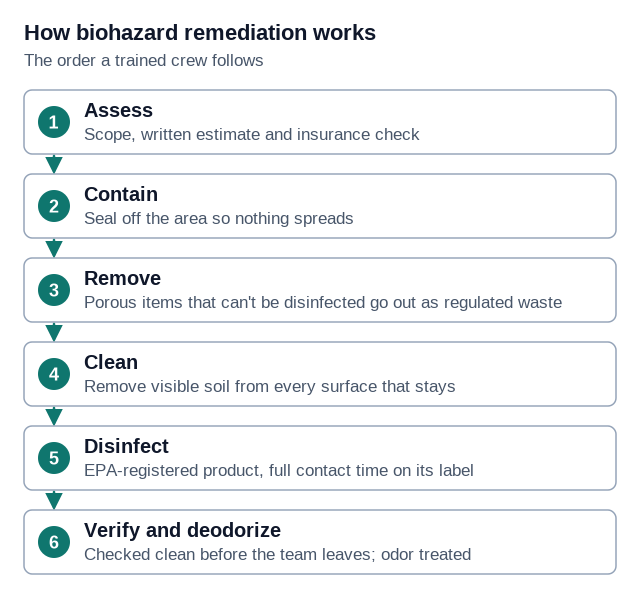
Plan for cleaning to start only after the Medical Examiner and any investigating agency have finished with the scene. Government Code § 27491(e) requires a funeral director, physician or other person who has charge of a body to notify the coroner immediately when the death falls within that section's causes or circumstances; in San Diego County the Medical Examiner holds the coroner's duties. Once the scene is released, ask any provider for its CDPH registration before it begins.
San Diego FAQs
Can CalVCB repay a San Diego family for crime scene cleanup?
Possibly. Government Code § 13957(a)(9) covers crimes that occur in a residence or inside a vehicle and lets the board reimburse any individual who voluntarily, and without anticipation of personal gain, pays or assumes the obligation to pay the reasonable cost of cleaning the scene, up to $1,709, and only for work by persons registered with CDPH as trauma scene waste practitioners. CalVCB's July 1, 2022 release says the limit rose from $1,000 to $1,709 for new applications submitted from that day. The application must also meet CalVCB's general eligibility and filing-time rules. CalVCB also calls itself a payor of last resort: applicants must first seek payment from medical, dental or vision insurance, public benefit programs, auto insurance, workers' compensation, court-ordered restitution and civil lawsuit recoveries, and must repay CalVCB if one of those sources pays later. The California guide on this site covers the statewide rules in more detail.
Our military family has already moved. Can the cleanup be arranged from a distance?
Much of it can, but someone, whether you, a property manager or the landlord, has to give the provider access. Ask for the provider's CDPH registration before work starts and keep its invoices: CalVCB's How To Get Compensated page says approved applicants must send proof of their costs to be reimbursed, and that applicants working with a victims advocate take their bills to the advocate, who submits them.
How can I check that a cleanup company is registered with the state?
Look for it on CDPH's Registered Trauma Scene Waste Management Practitioners list, linked from the department's Trauma Scene page, and check that you are using the newest copy, because the list states that only the latest version is valid.
Does a home seller or landlord in California have to disclose a death on the property?
Civil Code § 1710.2 says an owner or agent is not required to disclose an occupant's death on the property, or the manner of death, when it occurred more than three years before the buyer, tenant or renter offers to buy, lease or rent, nor that an occupant was living with HIV or died from AIDS-related complications, and no cause of action arises for those nondisclosures. It does not protect an intentional misrepresentation in answer to a direct question about deaths on the property, and it does not relieve an owner or agent of any duty to disclose the physical condition of the premises. For a more recent death, ask a real estate licensee or attorney.
Sources
- San Diego County Medical Examiner: The process
- San Diego County Medical Examiner: Frequently asked questions
- San Diego County Medical Examiner: Office overview
- San Diego County Medical Examiner: Fees
- San Diego County DEHQ: Medical waste management
- CalVCB: Crime scene cleanup service providers
- CalVCB: What is covered
- CalVCB: How to get compensated
- CalVCB: Local help, San Diego County
- CalVCB news release, July 1, 2022
- Government Code § 13957 (leginfo)
- Health and Safety Code § 117778 (leginfo)
- Health and Safety Code § 118321.3 (leginfo)
- Civil Code § 1710.2 (leginfo)
- CDPH: Trauma scene waste management practitioners
- CDPH: Registered trauma scene practitioners list (August 26, 2026)
- Cal/OSHA: Title 8 § 5193, Bloodborne Pathogens
- OSHA: California State Plan coverage
- eCFR: 29 CFR 1910.1030, Bloodborne pathogens
- Census Bureau: 2020 California places by county
- HomeGuide: Biohazard cleanup cost (third-party estimate, May 3, 2024) (third-party estimate)
Last reviewed 2026-11-06
Services Available in San Diego
Biohazard Cleanup
Professional remediation of biohazardous materials by trained, equipped local teams — discreet, thorough, and respectful.
Learn more →Crime Scene Cleanup
After authorities release the scene, discreet local teams restore the space — with help navigating insurance and state victim-compensation programs.
Learn more →Unattended Death Cleanup
Compassionate, discreet remediation after a loved one has passed alone — handled by trained local teams so family doesn't have to go back inside.
Learn more →Blood & Trauma Cleanup
Discreet professional cleanup after accidents and medical emergencies — trained local teams, safe disinfection, insurance-ready documentation.
Learn more →Hoarding Cleanup
Respectful, judgment-free hoarding remediation — local teams that work at the pace the situation and family need.
Learn more →Free Tools Before You Call
Ballpark the cost or narrow down the problem before talking to a San Diego provider.
Biohazard Cleanup Cost Estimator
A calm, honest cost range for professional cleanup — and why insurance often means families pay little out of pocket.
Use the free tool →Who Pays for Crime Scene Cleanup? State Victim Compensation Lookup
Most state victim compensation programs reimburse crime scene cleanup. Look up your state's coverage, cap, official source, and where to apply.
Use the free tool →What To Do After an Unattended Death — A Gentle Checklist
A calm, step-by-step guide for the first hours and days — answer three gentle questions and get a checklist for your exact situation.
Use the free tool →Need help in San Diego, CA?
Send the short form — urgent requests get priority routing.