Unattended Death Cleanup Cost in 2026
Unattended death cleanup typically costs $1,500 to $10,000, depending on how long before discovery and how far contamination spread (Fixr, HomeGuide). Homeowner's insurance usually covers this work, including removal and replacement of flooring and drywall, and professional teams bill the insurer directly — most families pay only the deductible.
If you're reading this after losing someone who died alone, we're sorry. No one should have to think about cleanup costs at a time like this, but knowing what to expect can take one uncertainty off your mind — especially the reassuring part: homeowner's insurance typically covers this work, and professional teams handle everything discreetly so family members never have to re-enter the space.
Unattended death cleanup runs $1,500 to $10,000, with most one-room jobs toward the lower end of that range (Fixr, HomeGuide). The main drivers are time before discovery (which determines how far remediation must extend) and whether structural materials like subflooring and drywall need removal. A free, no-obligation assessment is the only way to get a real number — this page gives honest planning ranges so you know what to expect before that call.
Biohazard Cleanup Team is a referral service. We connect families with independent local remediation teams who verify insurance coverage before work begins, bill the insurer directly, and work at whatever pace you need. Nothing on this page is a quote — it's sourced 2026 cost data to help you plan.
Typical national range
$1,500 – $10,000
Fixr reports $200–$300/hr for unattended death cleanup. HomeGuide puts most biohazard jobs at $1,500–$5,000; more extensive cases reach $10,000. Most one-room jobs fall in the $1,500–$5,000 range.
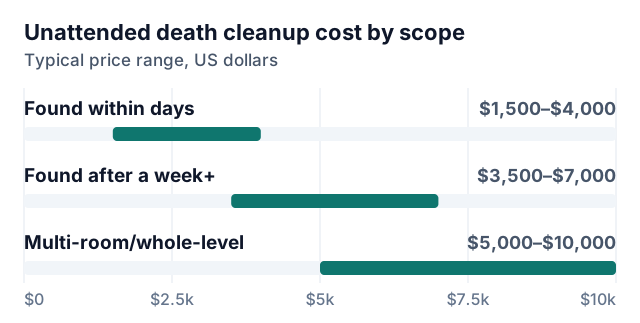
Unattended death cleanup cost by scope of work
| Item | Typical range | Notes |
|---|---|---|
| Unattended death cleanup (one room, found within days) | $1,500 – $4,000 | Base case: surface contamination on flooring and limited spread. Carpet and pad removed; hard surfaces cleaned and disinfected. |
| Unattended death cleanup (one room, found after a week or longer) | $3,500 – $7,000 | Extended time means contamination reaches subflooring and drywall, which must be cut out and replaced. |
| Multi-room or whole-level remediation | $5,000 – $10,000 | When HVAC has circulated air or fluids have spread beyond one room. Includes whole-home odor treatment. |
| Subfloor removal and replacement | $500 – $2,500 | Added when contamination has soaked through carpet pad into subfloor. Priced by square footage affected. |
| Drywall removal and replacement | $400 – $1,500 | Added when contamination or odor has reached walls. Includes baseboard removal. |
| HVAC and ductwork cleaning / odor treatment | $300 – $1,000 | When air has circulated through the system. May include ozone or hydroxyl generator treatment. |
| Personal belongings recovery and cleaning | $200 – $800 | Itemizing, photographing, and cleaning salvageable items — documents, photos, keepsakes — so family doesn't have to. |
What changes the price
Providers quote their own work — these are the factors that consistently move the number.
- Time before discovery is the primary driver: days versus weeks determines whether remediation stays on surfaces or extends into subflooring, drywall, and the air space. Summer heat and closed homes accelerate decomposition.
- Affected area: a single room is the base case. When fluids have spread to adjacent spaces or HVAC has circulated odor through the home, scope and cost increase.
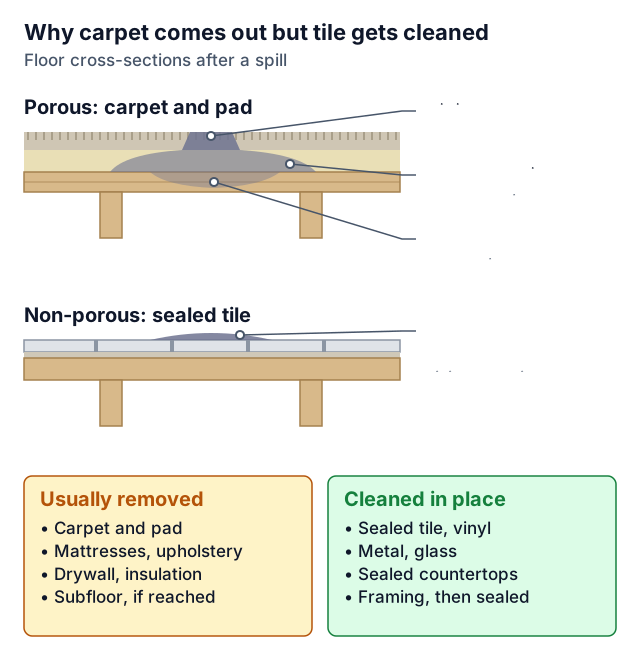
- Flooring type: carpet and pad almost always require removal ($500–$2,000 for the room). Hard surfaces can sometimes be cleaned in place.
- Structural involvement: when contamination has soaked into subfloor or drywall, those materials are cut out and replaced, adding $500–$2,500+ depending on square footage.
- Climate: warm, humid conditions speed decomposition and odor spread; a closed-up summer home costs more than a winter case discovered quickly.
- Odor treatment scope: limited room treatment is included in base pricing; whole-home treatment adds $300–$1,000 or more for ozone or hydroxyl generator work and duct cleaning.
Who pays for unattended death cleanup?
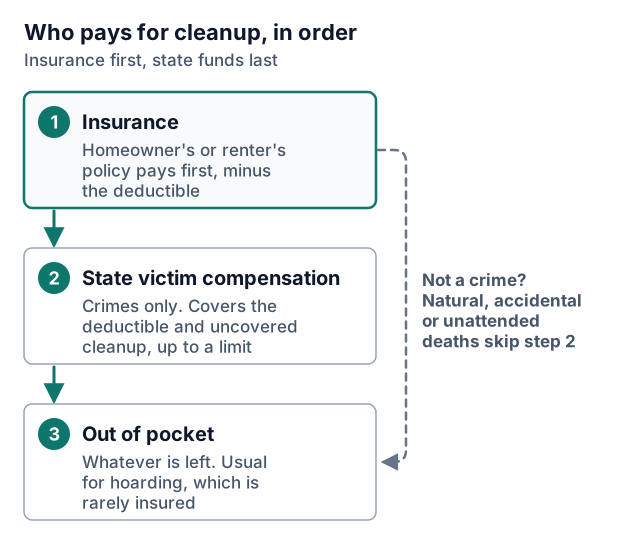
Most families don't pay the full cost out of pocket. Four payers cover most situations, described below. In practice, homeowner's insurance is applied first, and state victim compensation is the payer of last resort for crime-related cases.
Homeowner's insurance covers most unattended death cleanup. Policies typically include cleanup, removal, and replacement of flooring and drywall after a death in the home, and professional remediation teams verify coverage and bill the insurer directly. Many families pay only their deductible ($500–$2,500 typical).
Landlord or property owner's insurance covers remediation in rental properties. Under habitability rules, the landlord is generally responsible for making the unit safe after a death — the tenant's family is not liable for cleanup costs, and the security deposit cannot be applied to death-related cleanup. The landlord's building insurance handles the claim.
Estate pays when the deceased owned the home and no homeowner's policy is in force. The cost comes out of the estate before distribution, handled by the executor. Many teams offer payment plans when this is the only payer.
State victim compensation reimburses crime scene cleanup costs that insurance doesn't cover. Published cleanup caps run from $500 in Pennsylvania to $7,000 in Alaska; a few states cover cleanup within their overall award limit instead, and some, such as Washington, don't pay for cleanup at all. This is the payer of last resort — insurance is applied first. See our state-by-state victim compensation lookup at /tools/crime-scene-cleanup-victim-compensation-by-state.
What affects unattended death cleanup cost the most?
Time before discovery is the single biggest factor. Discovered within 24–48 hours, cleanup may be limited to the immediate area: carpet, pad, and hard-surface cleaning. After a week or longer — especially in warm conditions — contamination extends into subflooring, drywall, and the air space. That's when jobs move from the $2,000–$4,000 range into the $5,000–$10,000 range.
The affected area matters because odor and contamination spread. When HVAC has run, it pulls air from the source room and circulates it through the home. Ductwork cleaning, whole-home odor treatment, and checking other rooms for spread all add scope.
Flooring type changes removal costs. Carpet and pad soak up contamination and almost always need removal. Hard surfaces like tile or sealed hardwood can sometimes be cleaned and disinfected in place. Unsealed wood, laminate with gaps, and concrete absorb contamination and may need sealing or replacement.
Structural involvement drives the top of the range. When subflooring or drywall must be cut out and replaced, the job crosses from remediation into light construction. This is common in longer-elapsed cases or when contamination reached a bathroom or kitchen with wall-to-floor transitions.
How cleanup is priced: hourly vs. flat-rate
Fixr reports unattended death cleanup crews charge $200 to $300 per hour (HomeGuide reports $25 to $150+ per hour for general biohazard cleanup; the higher rate accounts for the specialized nature of decomposition work). Most companies quote the job flat after an on-site assessment rather than billing by the hour, so the hourly rate is useful mainly for understanding why a five-hour job (one room, limited scope) costs less than a three-day job (whole level, structural removal).
Disposal of regulated waste (biohazardous materials, carpet, pad, drywall) is manifested and billed by weight, usually included in the flat quote. Some companies itemize it separately. Ask what's included before authorizing work.
Materials for structural repairs — subflooring panels, drywall, baseboards, paint — are additional when the remediation company handles them, or you can have a general contractor finish after the remediation team clears the space.
What professional cleanup includes
A reputable unattended death cleanup includes: removal and lawful disposal of all contaminated materials (carpet, pad, subfloor sections, drywall), cleaning and disinfection with EPA-registered products, odor neutralization (enzymatic treatment, ozone or hydroxyl generators, HVAC treatment where needed), respectful recovery and cleaning of personal belongings, photographs, and documents the family wants to preserve, and documentation to insurer standards so your claim goes smoothly.
What it doesn't include (unless added): structural repairs beyond tear-out (drywall finishing, painting, flooring installation), estate cleanout of unaffected belongings, or deep cleaning of the rest of the home. Many teams offer these as add-ons, or you can hire separately.
Timeline: how long cleanup takes
A one-room job with limited scope typically takes 4–8 hours. Multi-room or structural cases take 1–3 days. Whole-home odor treatment may require an additional 24–48 hours for ozone generators to run and ventilate before the home is safe to occupy.
Families often want the work done quickly so they can move forward, and most teams accommodate same-day or next-day starts once the scene is released. Others prefer to wait a few days before arranging anything — that's fine too. The work can wait until you're ready.
How location changes the number
Local labor rates and disposal fees shift the final quote. Urban metros tend to be 10–20% higher than rural areas.
Summer heat in Southern states accelerates decomposition, which moves more jobs into the upper half of the range. Winter cases in colder climates are often less extensive.
State victim compensation caps vary, which affects what families pay out of pocket after a crime. Our state-by-state lookup shows your state's program.
Frequently Asked Questions
How much does unattended death cleanup cost?
Unattended death cleanup typically costs $1,500 to $10,000, depending on time elapsed and affected area. Most one-room cases fall in the $1,500–$5,000 range (HomeGuide). Jobs that require subfloor and drywall removal run $5,000–$10,000. Homeowner's insurance usually covers this work, and teams bill the insurer directly.
Does homeowner's insurance cover unattended death cleanup?
Usually, yes. Most homeowner's policies cover cleanup, removal, and replacement of flooring and drywall after a death in the home. Professional remediation teams verify coverage before work begins and bill the insurer directly — many families pay only their deductible. Coverage depends on your policy's terms, so teams confirm specifics before starting.
Why does cost increase the longer before discovery?
Time determines how far remediation must extend. Found within a day or two, cleanup may be limited to surfaces and carpet in one room. After a week or longer, contamination soaks into subfloor and drywall, and odor spreads into the air space and HVAC system — all of which must be addressed. That's the difference between a $2,000 job and a $7,000 job.
Who pays for cleanup in a rental?
The landlord, through the property's building insurance. Under habitability rules, the landlord is responsible for making the unit safe after a death — the tenant's family is generally not liable for cleanup costs, and the security deposit cannot legally be applied to death-related cleanup. The family handles personal belongings; the landlord handles remediation.
Does the family have to re-enter the home during cleanup?
No. Teams routinely work from a key handoff and handle everything inside, including recovering and cleaning personal belongings, documents, and keepsakes the family wants to preserve. Many families choose not to return until the work is complete. That's normal and expected.
How soon should cleanup happen after the scene is released?
Sooner is generally better for limiting scope — but a day or two to breathe and gather family won't significantly change the outcome. Secure the home, turn off the HVAC to limit odor spread, and call when you're ready. Most teams can start same-day or next-day once the medical examiner or coroner has released the scene.
Estimates only — independent local providers quote their own pricing. Data last reviewed 2026-11.
Sources
- Fixr — Biohazard Cleanup Cost Guide (updated Jan 31, 2025) (third-party estimate)
- HomeGuide — Biohazard & Crime Scene Cleanup Costs (third-party estimate)
- OSHA — Bloodborne Pathogens Standard, 29 CFR 1910.1030
Related services
Free tools for this job
Biohazard Cleanup Cost Estimator
A calm, honest cost range for professional cleanup — and why insurance often means families pay little out of pocket.
Use the free tool →Does Insurance Cover Biohazard Cleanup? A 60-Second Answer
Answer two or three simple questions and get an honest read on who pays for cleanup — insurance usually covers more than families expect.
Use the free tool →Cities We Serve
Prefer to just talk to someone?
Send the short form — we'll route you to an independent local pro.